
Real estate is an extremely reliable methods to accumulate wealth, earn an income that is passive and provide lasting financial security. However, one question is still dividing investors: residential vs commercial investment -- which has the better return?
There isn't an answer that is universal. The best investment is based on your budget and risk tolerance, goals for income, financing capabilities and your time period. A residential property in a location that is growing rapidly is more profitable than the weak commercial property. A prime retail or office asset can generate a higher monthly income than a number of residential properties.
This comprehensive guide will help you compare commercial and residential real estate with respect to every major factor, including rental yield, ROI appreciation liquidity, risk as well as tax benefits and the investment potential in India.
What Is Residential Property Investment?
Residential property investment is the purchase of properties intended for use as a living space. Investors buy these assets for rental purposes, profit from capital appreciation, or both.

Common Types of Residential Properties
- Apartments
- Villas
- Independent houses
- Builder floors
- Residential plots
- Gated community homes
- Holiday homes
Why Investors Choose Residential Real Estate
Residential investment is often the first entry point for new investors because it is easier to understand, easier to finance, and backed by consistent housing demand.
Main Income Sources
-
Monthly rent
- Long-term price appreciation
- Resale profit
- Short-term furnished rental income in select markets
What Is Commercial Property Investment?
Investing in Commercial Property is an investment in real estate that will be used for the purpose of conducting business operations. Commercial property can be leased out to different types of businesses, including Retailers, Logistics, and Professionals

Common Types of Commercial Properties
- Office spaces
- Retail shops
- Showrooms
- Warehouses
- Co-working spaces
- Business parks
- Industrial units
- Mixed-use commercial assets
Why Investors Choose Commercial Real Estate
Commercial property investments typically have a higher rental income than Residential Property Investment. Secondly, the average length of a commercial lease is generally longer than the average length of a residential lease, resulting in more stable and predictable monthly cash flow from your investment than you would receive via residential property.
Main Income Sources
- Lease rentals
- Annual rent escalation
- Capital appreciation
- Premium lease renewals
Residential vs Commercial Investment – Quick Comparison
|
Factor |
Residential Investment |
Commercial Investment |
|
Entry Cost |
Lower |
Higher |
|
Rental Yield |
Moderate |
Higher |
|
Tenant Duration |
Shorter |
Longer |
|
Vacancy Risk |
Lower |
Higher |
|
Loan Availability |
Easier |
Stricter |
|
Maintenance |
Simpler |
More Complex |
|
Liquidity |
Better |
Slower |
|
Risk Level |
Lower |
Moderate to High |
|
Appreciation |
Stable |
Location Driven |
|
Management Need |
Low to Medium |
Medium to High |
Rental Yield – Which Generates Better Monthly Income?
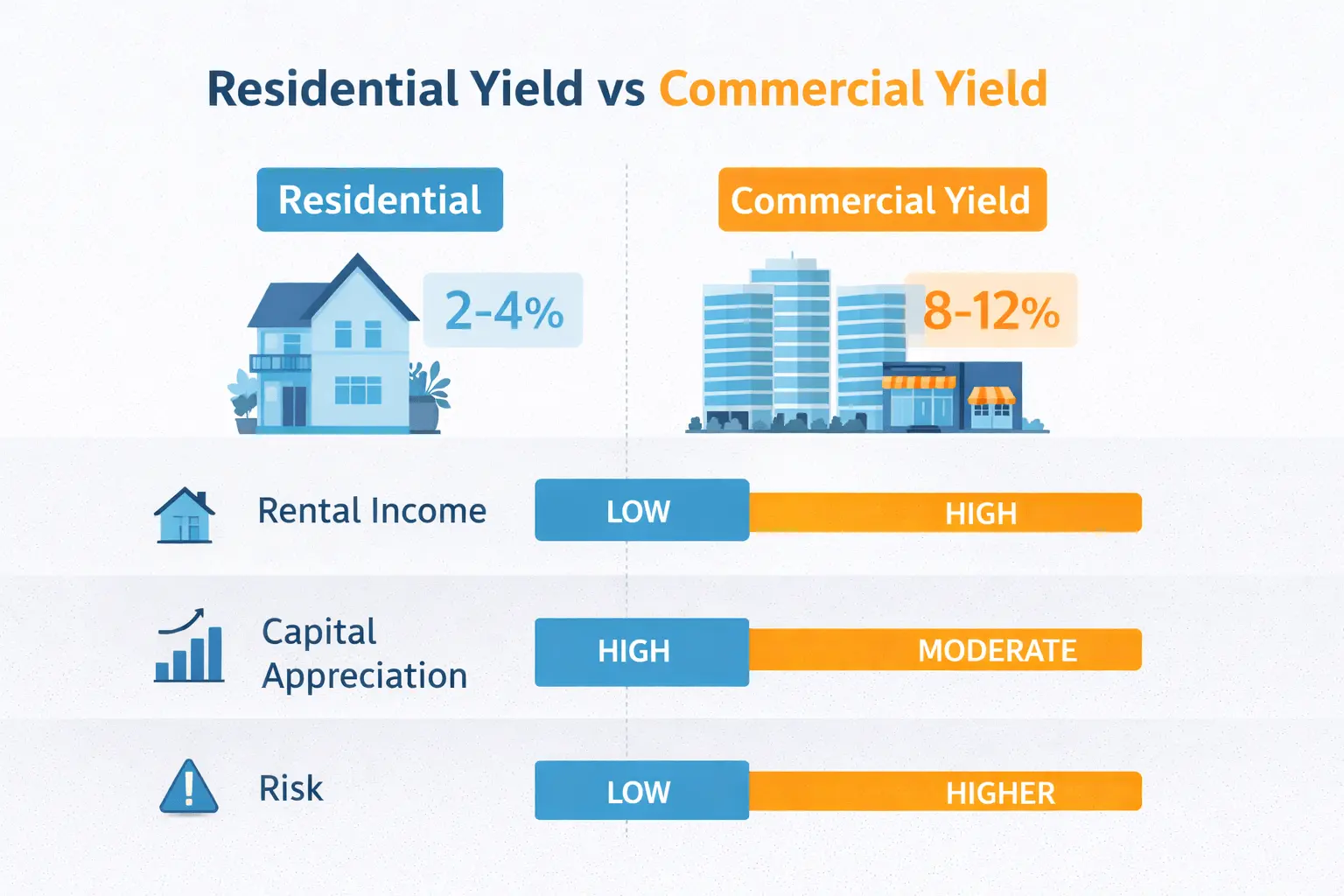
Rental yield can be an important part of investing in real estate, as it measures the amount of money that you will receive in profit from an investment property relative to the cost of the property.
Residential Rental Yield
Residential rental yields can generally provide a steady source of income, but not necessarily at the highest levels. Rentals are often in demand from various groups of people, including students, families, working people, and people that are moving across town, or from out of town or country.
Investing in residential rental properties offers several advantages, such as: - The ease of finding a tenant since there is an abundance of people seeking housing. - You may reduce vacancy rates and empty units in your property by selecting an appropriate area to invest in.
- Consistent rental demand helps ensure steady cash flow.
Commercial Rental Yield
Investing in commercial real estate has its own benefits. Generally speaking, you will likely get higher returns from your investment as businesses typically pay higher amounts for aesthetically pleasing buildings and to be located near other businesses that are also good for their business development.
Benefits of commercial real estate investing include:
- Rent per square foot is higher than residential;
- Security deposits are larger;
- Lease terms are longer;
- The rental increases that you will receive from your tenant’s initial lease signing are contracted with specific increases at designated times.
Verdict
If one of your main reasons for investing is to generate income or passive income from your investment, generally you will receive higher returns by investing in commercial real estate.
Capital Growth – Which Grows Faster?
Capital Appreciation refers to the increase in value of an asset over time. Capital appreciation is one of the most important value-adding components to a real estate investment
Factors Influencing Residential Appreciation
- Population Growth
- Infrastructure Development
- Metro Accessibility
- Schools and Hospitals Nearby
- End-User Housing Demand
- Government Development Programs
Commercial Appreciation Drivers
The following are likely to drive the value of commercial property units upwards:
- Business Expansion
- Commercial Development
- Retail Demand
- Employment Base Development
- Logistics Corridor Development
- Limited Availability of Prime Commercial Locations
Conclusion
Typically a residential property will maintain a regular appreciation in value over time. However, the market for commercial properties has the potential to generate higher returns in areas with high growth, but there is usually more risk.
ROI Comparison – Residential vs Commercial Real Estate
ROI includes far more than simply the rental income you receive. A thorough analysis of the ROI associated with a property ownership includes many additional factors including the
- Purchase price
- Stamp duty/registration fee costs
- Maintenance cost for property
- Rental voids
- Interest!
Residential ROI
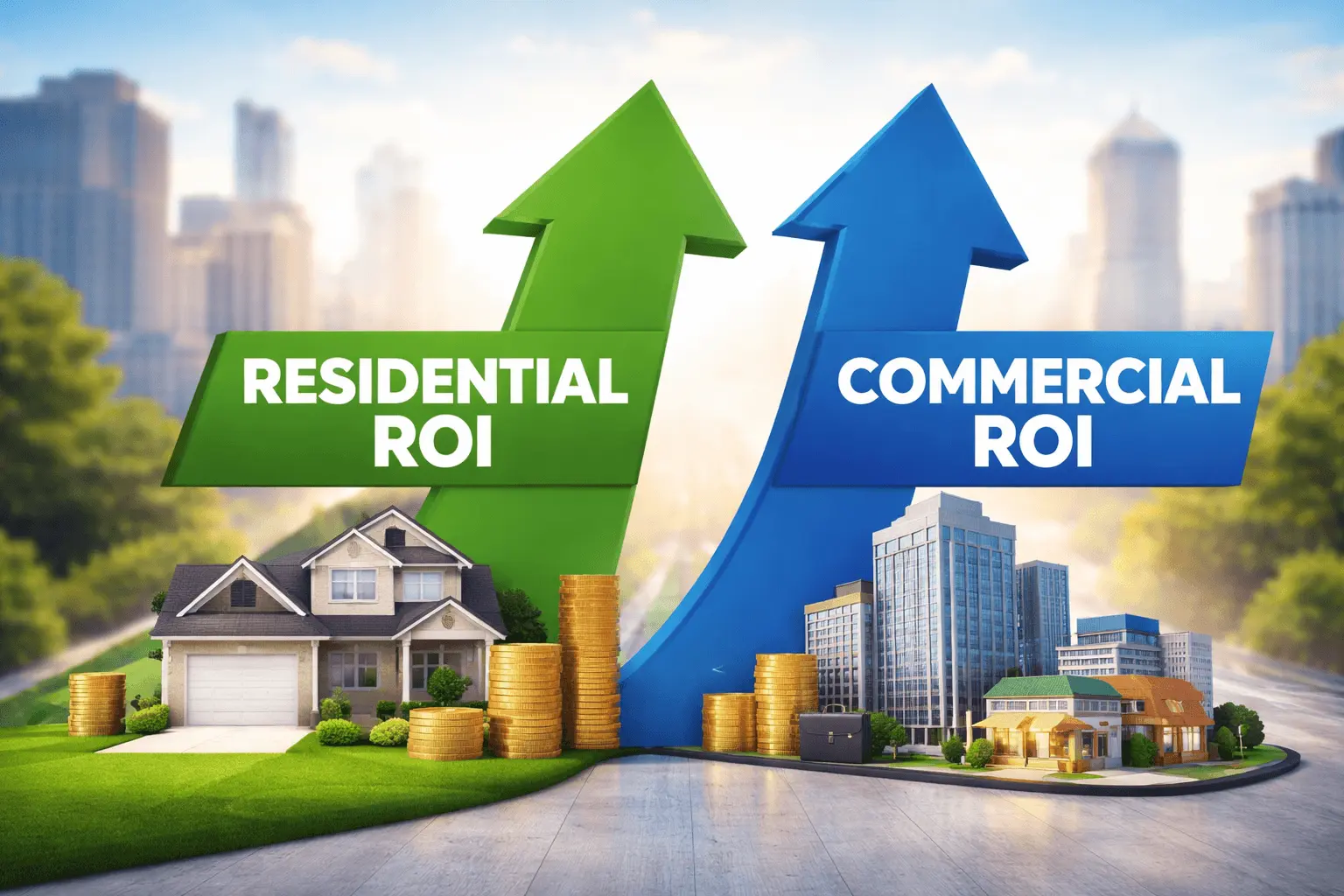
ROI on Residential Property Although the rental income can be lower for ROI, residential properties generally appreciate much more over time compared to commercial properties when located in expanding cities.
Commercial ROI
Commercial ROI can yield higher returns through rental income; however, the risk of vacancy can significantly impact overall returns if the property remains unoccupied.
Honest Conclusion
Don’t let the label fool you. A commercial property can actually do worse than solid residential properties. What really counts is the quality of the asset, not just the category it falls under.
Risk Factors You Must Understand
Chasing high returns without truly understanding the risks? That’s where a lot of people trip up. It’s a common and expensive mistake.
Residential Investment Risks
- Tenants come and go.
- Sometimes rent arrives late.
- Small maintenance jobs pop up all the time.
- You’ve got society charges to handle.
- If the market’s flooded with options, property values creep up slowly.
Commercial Investment Risks
You’ll probably deal with longer vacancies in commercial properties. If your tenant’s business shuts down, you’re back to square one, searching for a new tenant.
And when the economy slows, finding businesses to fill your space gets even tougher. Tenants also tend to expect higher-quality fit-outs than what you need for a house or apartment.
Maintenance costs can add up fast, and when you want to sell, your pool of potential buyers is much smaller.
Conclusion
Commercial properties pay more because you’re taking on more risk.
Financing and Home Loan Comparison
Residential Property Loans
Banks like lending for homes since there’s always strong demand. That means you get better loan terms overall: longer repayment periods, lower interest rates (a lot of the time), and easier requirements. You don’t need to make such a big down payment, either.
Commercial Property Loans
Getting a loan for a commercial property is tougher. You’ll have to put down more cash upfront, pay higher EMIs, and your loan tenure is usually shorter. Lenders also take a hard look at your income and ability to pay.
Conclusion
It’s just a lot easier to get financing for a home than for a commercial property.
Tax Benefits – Residential vs Commercial Investment
Tax rules change depending on the country, your ownership setup, and who you are as an investor—but you’ll notice a few common trends.
Residential Tax Advantages
-
You can often deduct home loan interest.
- Principal repayments sometimes come with benefits.
- Many places let you deduct certain rental property costs.
- You get special treatment for long-term capital gains if you meet the requirements.
Commercial Tax Advantages
- Interest costs are deductible here too.
- You can claim a wider range of business expenses.
- Some setups let you depreciate the property.
- There’s usually more room for creative tax planning, especially for businesses and professionals.
Conclusion
Residential taxes are generally simpler to understand. If you want more ways to optimize, commercial deals offer that—especially if you’ve got a good tax advisor in your corner.
Liquidity – Which Property Sells Faster?
Liquidity is all about how quickly you can turn your property into cash.
Residential Liquidity
Homes tend to move faster in the market. You’ve got plenty of potential buyers—end users, families looking for a place to live, first-timers, plus investors.
Commercial Liquidity
Selling commercial property usually takes longer. Your buyer pool is smaller, and most of them want strong returns, so they’re pickier about what they buy.
Conclusion
If you want a quicker sale, residential property is typically the better bet.
Which Is Better for Beginners?
If you are a first-time investor with limited capital, residential property is usually the smarter starting point.
Reasons:
- Easier loan access
- Simpler tenant management
- Better resale flexibility
- Lower complexity
Commercial works better when you understand location economics, leasing structure, and risk management.
Residential vs Commercial Return On Investment in India
India’s real estate scene has something for everyone, but picking the right spot changes everything.
Noida
Greater Noida
Gurgaon
Bangalore
Strong Residential Markets
Some cities really stand out for homes: Noida, Greater Noida, Gurgaon, Bangalore, Pune, Hyderabad, and Chennai all top the list. People want good neighborhoods, jobs nearby, and growing infrastructure—these places deliver that.
Strong Commercial Markets
When it comes to offices, shops, or warehouses, it’s less about specific cities and more about pockets within them. IT corridors, central business districts, busy retail streets, industrial areas, logistics hubs, and even office spaces connected by metro lines—all of these zones attract serious commercial activity.
Key Growth Drivers in India
A few things keep pushing the market forward: new expressways, expanding metro networks, fresh airports, ongoing corporate hiring, smart city projects, and constant investment in infrastructure.
But here’s the truth—even in a big-name city, a bad location means your investment can flop. Don’t just go by the city; get into the details of each micro-market before you buy.
Best Strategy for Serious Investors
The smartest investors often stop arguing “residential vs commercial” and build a balanced portfolio.
Example Portfolio Approach
- Own a residential property for steady growth and long-term value.
- Add a commercial property for bigger monthly cash flow.
- Keep some cash on the side so you’re ready when a good deal pops up.
- Reinvent rental income back into the mix regularly.
This way, you get the best of both worlds—steady growth plus real cash in your pocket.
Final Conclusion – Residential vs Commercial Investment
Go with residential investment if you’re looking for lower risk, easier financing, simpler management, better liquidity, and stable long-term growth. Commercial investment makes sense if you want higher rental yields, stronger monthly income, longer lease terms, higher ROI potential, and a chance to tap into busy business districts.
If you have enough capital and want to diversify, owning both is the way to go.
Don’t get stuck asking, “Which is better overall?” The real question is, “Which fits my budget, my timeline, and how much risk I’m comfortable with?” That’s the kind of thinking that sets smart investors apart.